Here’s a detailed overview of the Land Rover Defender (modern generation) — its heritage, key specs, versions, features, pros/cons, and what you should know if you’re looking at one in India.
1. Heritage & background
- The “Defender” name traces its roots to the original Land Rovers launched in the late 1940s; the series evolved through the 1980s/90s, with the “Defender” name formally adopted around 1990.
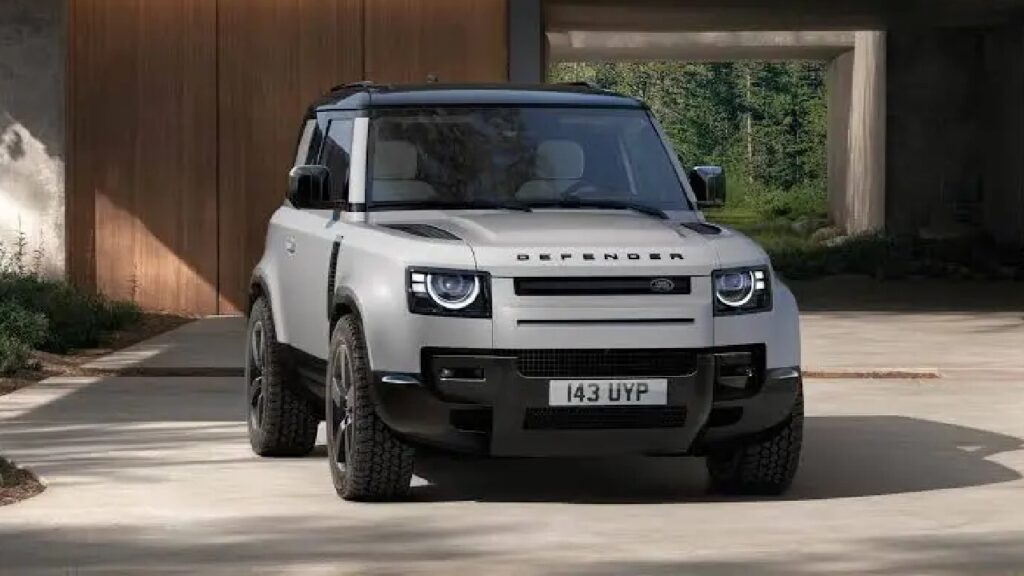
- The current generation (model code L663) was introduced in 2019 (for model-year 2020) as a reinvention of the Defender for the 21st century: tougher, tech-rich, yet retaining off-road DNA.
- In India it was launched in October 2020 with variants such as the Defender 90 and Defender 110.
2. Versions & body styles
The modern Defender is offered in several body lengths / versions:
- Defender 90: Shorter wheelbase, more compact (for five seats or 5+2 depending on layout.
- Defender 110: Longer wheelbase, more space for passengers and luggage, more “everyday family” friendly.
- Defender 130: The longest version (in some markets) that offers third row and more load space. There are also high-performance variants (e.g., V8) and special editions (e.g., “OCTA” variant) depending on market.
3. Key specifications & capability
Here are many of the important specs for the modern Defender (India / global context):
- Platform / architecture: Uses the D7x aluminium monocoque body structure, claimed to be up to 3× stiffer than comparable body-on-frame SUVs.
- Off-road geometry & capability:
- Ground clearance up to about 291 mm in off-road height.
- Maximum wading depth of about 900 mm (i.e., can drive through water up to that depth) when properly equipped.
- Approach / break-over / departure angles are very good: e.g., approx 38°/28°/40° for the 110 in off-road height.
- Powertrains: Varies by market, but examples include:
- 2.0 litre turbo petrol (for example in India) producing ~300 PS (≈ 221 kW) and ~400 Nm torque.
- 2.0 litre turbo diesel, 3.0 litre six-cylinder petrol or diesel mild-hybrid, and higher performance V8 versions in some markets.
- Seating / Load:
- In the 110, you can get 5, 6 or 5+2 seating. Behind the second row you may have about 1,075 litres of loadspace, and up to ~2,380 litres when seats are folded (some specific markets) .
- Technology & interior:
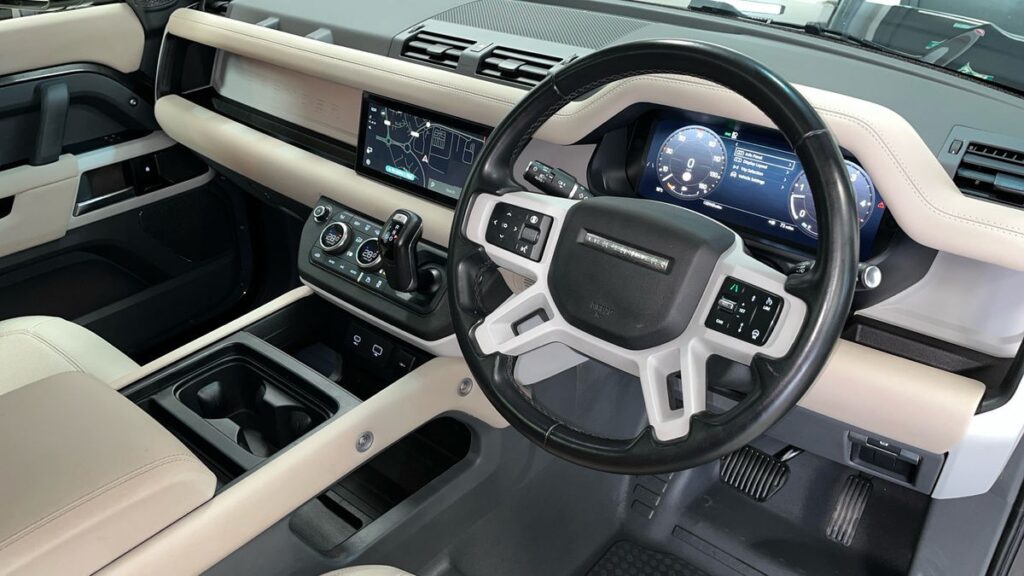
- Infotainment: Pivi Pro system, large touchscreen, connected navigation, over-the-air updates.
- Safety / assistance: Various driver assist systems (lane keep assist, emergency braking, 360° cameras, etc).
- Prices in India (as of launch): Launched from about ₹ 73.98 lakh (for certain trims) and up.
4. Why it’s good / what stands out
- Off-road & all-terrain capability: It’s one of the few luxury SUVs that very clearly retains serious off-road hardware (very good ground clearance, wading depth, off-road modes like Terrain Response 2 & Configurable Terrain Response) which means it can handle more rugged terrain.
- Strong design & rugged authenticity: It keeps the distinctive silhouette, minimal overhangs, etc. The name “Defender” carries heritage and the feeling of a real 4×4 rather than just a luxury SUV.
- Luxury & tech mixed with utility: You get premium interiors, modern tech (infotainment, connectivity, safety) plus utility features (durable flooring, good storage, practical layout) which make it fairly usable in real life and not just show-piece.
- Flexibility & personalization: Lots of model variants, accessory packs, and customisation options (in example markets) to tailor for lifestyle / off-road / ruggedness.
5. What to watch / potential drawbacks
- Price & running cost: As a luxury off-road capable SUV, the upfront price is high and maintenance/servicing likely more expensive than mainstream SUVs.
- Fuel efficiency: Large size + robust off-road hardware + powerful engines means fuel economy will lag many less capable SUVs.
- Size / practicality in city traffic: Especially the longer body styles (110 / 130) may be large, less manoeuvrable in tight urban environments, parking might be challenging.
- Complexity: With advanced tech and systems (air suspension, many drive modes, electronics), there is potentially higher risk of higher repair/maintenance cost compared to simpler vehicles. Indeed one potential buyer wrote: “What are the most common issues with the 2023 Defender 90 SE … I know the Defender 110 is more popular.”
- Depreciation / resale: Luxury SUVs often depreciate; the niche nature (off-road capable luxury) may help a bit, but still something to consider.
- Availability and parts: In markets like India, some parts might take longer, or cost of parts / import duty may add.
6. In the Indian context
- The new Defender was launched in India in 2020 (with bookings open) and variants included the 90 (short wheelbase) and 110 (longer), with petrol and potentially diesel options.
- Pricing was steep (indicative of luxury SUV segment) and you must factor in high insurance, servicing cost and possibly higher fuel cost.
- Off-road capability is a plus in Indian terrain (if you travel off the beaten path) but if your usage is mostly city/highway, you might maybe consider trade-offs (size, cost, practicality) versus other luxury SUVs.
- Given its capability, it sets itself apart from many luxury SUVs that prioritise on-road comfort only.
- Make sure servicing network is good, spares availability is confirmed, and factor in total cost of ownership.
- Also check the variant you are buying (engine, trim, drivetrain) to ensure it meets your needs (city vs off-road vs family usage).
7. Summary
If I sum up:
The Land Rover Defender is a luxury off-road SUV that merges serious off-road capability with modern luxury and tech. It’s especially appealing if you value ruggedness, adventure, unique design, and don’t mind the higher cost and some trade-offs in city use. If you’re mostly city/highway driving with minimal off-road usage, you might ask whether you need this level of off-road capability or if another luxury SUV would suffice.